


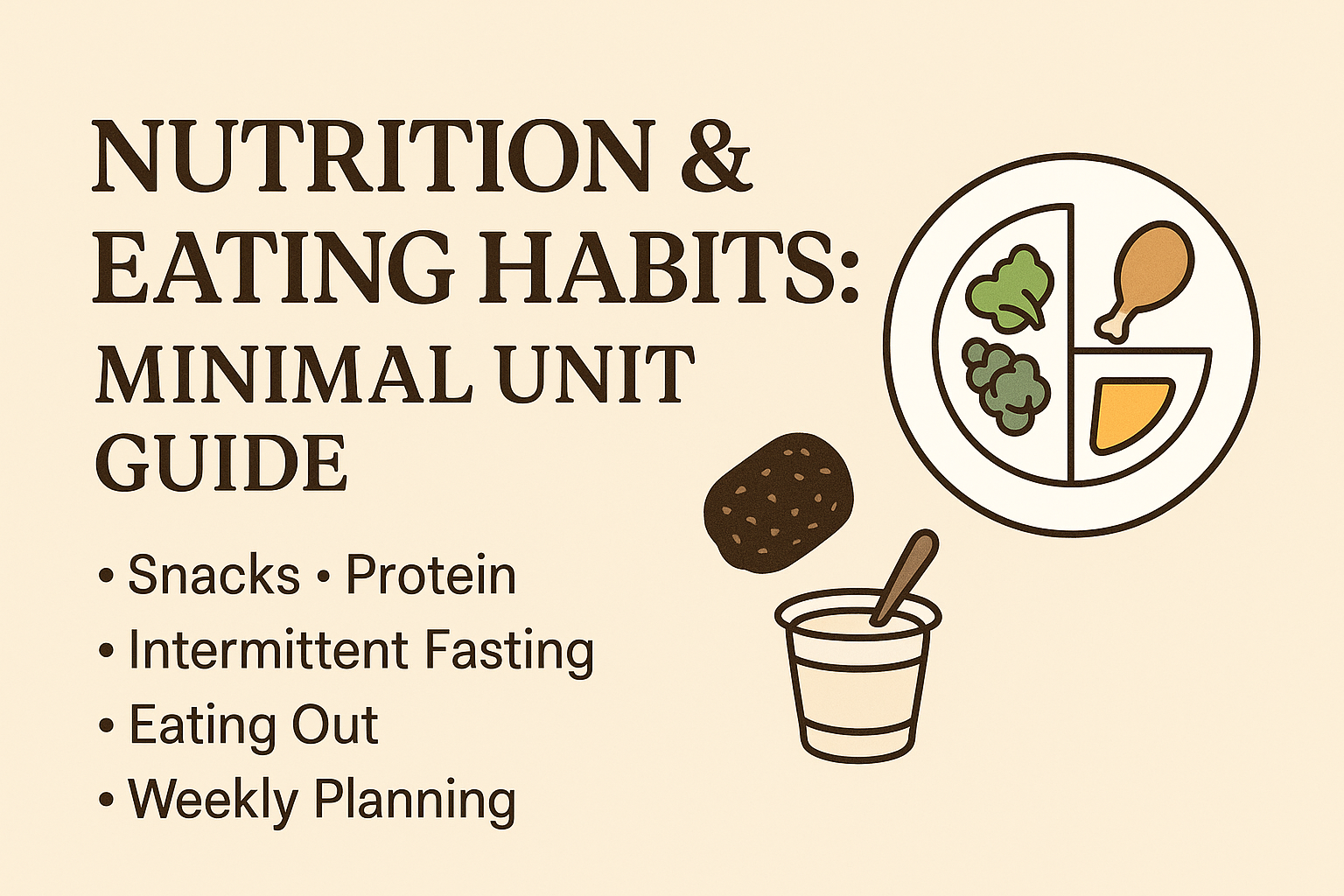
How one snack can reshape your whole day
“I should start eating healthier…”
But then you get stuck on where to begin, so nothing actually changes.
This hub page is made to remove that overwhelm —
it’s a guide to breaking nutrition and eating habits into the smallest possible pieces.
Each sub-post will go deep into a specific topic.
Here, we’ll stay high-level: big picture, simple frameworks, and curiosity-sparking ideas you can start thinking about today.
🧩 Why “smallest units” matter
To change how you eat,
you don’t need a “perfect, rigid meal plan”.
You need tiny, sustainable units of change.
- 100 squats one time does less for you than
10 squats a day for a month. - Same for food:
“20 rules you’ll never follow” are less powerful than
“2–3 rules you can keep even on a bad day”.
So this series focuses not on huge overhauls but on questions like:
- How do I upgrade just one snack?
- How can I roughly spread my protein across the day?
- Is intermittent fasting even safe or appropriate for me right now?
- How do I make slightly better choices when eating out?
- How can I sketch a weekly plan that reduces stress, not adds to it?
In short, we work with “the smallest unit you can act on today.”
🥨 Big picture: high-satiety snack swaps
Snacks are usually associated with “guilt”,
but in reality, snacks can be tools for stabilizing your whole day.
The core idea is simple:
❝ For the same calories,
choose the snack that keeps you full longer ❞
On this hub page, we’ll skip precise calories and grams and
focus on the direction:
- Sugar & white flour → more protein & fiber
- “I’m bored, so I snack” → “This snack helps me reach the next meal comfortably”
- Sweet + fatty combos → less added sugar, more protein/fiber
In the dedicated post (High-Satiety Snack Swap Table), we’ll:
- Take real snacks from convenience stores / cafés / home
- Show “If you usually eat this → try swapping to this”
- Organize it in tables and checklists
For now, just remember:
Snacks aren’t the enemy.
They’re something you can make smarter, not just smaller.
🍗 Protein distribution: a simple “3-part day” mindset
When people think about protein,
they usually start with:
“How many grams per day do I need?”
Helpful, yes — but often what matters just as much is:
“How evenly is that protein spread across the day?”
A common pattern looks like this:
- Breakfast: almost nothing, maybe bread + coffee
- Lunch: mostly carbs
- Dinner: “Time to compensate!” → heavy protein & overeating
Instead of obsessing over numbers,
this series suggests a simple 3-part frame:
- For breakfast, lunch, and dinner,
ask once: “What’s the main protein in this meal?” - Use snacks as a chance to sneak in a bit more protein
- On workout days vs rest days,
adjust your protein distribution with a basic sense of timing
In the full post (Protein Distribution Guide), we’ll cover:
- Rough, realistic rules of thumb (like “palm-size” portions)
- Sample days for office workers, students, remote workers
- Solutions if you’re “not a breakfast person”
Here, the one takeaway is:
❝ Protein isn’t only about “how much”.
It’s about how you spread it across your day. ❞
⏰ Intermittent fasting: safety check first, trend later
Intermittent fasting (IF) often looks like
a slick, efficient strategy on social media.
But for some people, it’s absolutely not something to start casually.
On this hub page, there’s one main message:
❝ Intermittent fasting isn’t just a “trendy diet”.
It’s a strategy that requires a safety check first. ❞
So the IF part of this series isn’t
“Here’s a fasting schedule, go follow it,”
but rather: “Should I even be doing this right now?”
At a high level, we’ll look at:
- How are your sleep, stress, and binge patterns lately?
- Have you ever had bad experiences with strict diets?
- Any conditions, medications, pregnancy/breastfeeding, etc.?
→ In many such cases, you must talk to a professional first. - And beyond fasting windows,
“What and how do you eat during your eating window?”
In the detailed post (Intermittent Fasting Safety Checklist), we’ll include:
- A simple self-check list
- A clear list of “Not a good idea right now if…”
- Guidance for people already doing IF on how to
adjust to protect their health
All of this will be shared as general information, not medical diagnosis.
🍱 Eating out: “similar taste, better choice”
Let’s be real:
a life without eating out is not happening.
So the goal isn’t to cut restaurant food.
It’s to do this:
❝ Within the foods you already like,
make a 1–2 step better choice. ❞
On this hub page, we’ll stay conceptual:
- Instead of changing the entire dish,
start with cooking method / toppings / sides - Don’t chase “perfectly clean”,
aim for “better than my usual choice” - Keep taste and satisfaction in place,
while gently reducing the oil + sugar + refined flour combo
In the full post (Eating Out Swap Guide), we’ll cover:
- Common categories: Korean/Japanese/Western/fast food, etc.
- Concrete tables like:
“If you often order this → try this instead” - Even suggested phrases for orders or special requests
Here, just keep this idea:
❝ Eating out isn’t a moral failure.
It’s a practice ground for smart menu swaps. ❞
📅 Weekly nutrition & habit templates: a light-touch approach
“Meal planning” often makes people think
of strict spreadsheets and stress.
This series’ weekly plan templates are much lighter.
The goal is:
❝ From Monday to Sunday,
design just a rough rhythm, not a rigid plan. ❞
For example:
- Mon–Fri: simple default pattern at home/work
- Wed/Fri: planned eat-out or delivery days
- Sat: social life / invitations – kept more flexible
- Sun: light prep (groceries, basic snack setup)
Even this small frame can:
- Reduce the daily “What should I eat today?” decision fatigue
- Put snacks and eating out inside a plan,
which helps reduce guilt
In the detailed Weekly Template post, we’ll include:
- Printable/downloadable weekly templates
- Examples for office workers, students, remote workers
- Tips on avoiding perfectionism so the plan stays realistic
🚀 Three tiny actions you can take after reading this
You don’t need to remember everything from this page.
Just three small actions are enough to get started.
- Pick one snack to upgrade
- Choose a specific snack and decide:
“From now on, I’ll look for a more filling version of this.”
- Choose a specific snack and decide:
- Ask one question about one meal
- For any meal today, ask:
“What’s the main protein here?”
→ If nothing comes to mind, that’s the meal you can gently improve.
- For any meal today, ask:
- Write one line about your weekly rhythm
- Describe your usual pattern:
“Mon–Fri I eat like this, weekends are usually like that.”
That’s already the first draft of your weekly template.
- Describe your usual pattern:
🔗 Sub-posts in this series (planned)
Each article below will zoom into one of the “smallest units” from this hub.
Titles and links can be adjusted when you publish on your blog.
- High-Satiety Snack Swap Table
→ Convenience store / café / home snack swaps for longer fullness, similar enjoyment - Protein Distribution: Real-Life Day Examples
→ Sample protein patterns for office workers, students, night owls, remote workers, and more - Intermittent Fasting: Safety Checklist Before You Start
→ A self-check guide to see whether IF fits your current health and life situation - Eating Out Swap Guide: Practical Restaurant Choices
→ Swaps for popular chains and restaurant types, with realistic alternatives you’ll actually order - Weekly Nutrition & Habit Templates + Examples
→ Weekly plan examples based on real-life routines, plus ready-to-use templates